Newsletter Subscribe
Enter your email address below and subscribe to our newsletter

 ByJohn A
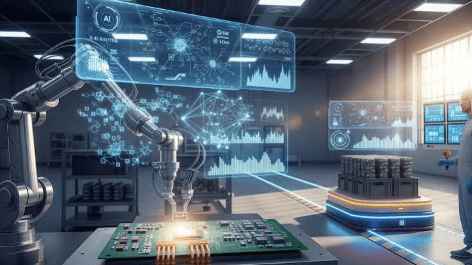
AI acts as a data-driven controller in industrial settings, translating sensor inputs and constraints into actionable decisions. It predicts deviations, calibrates models, and enforces optimal setpoints through feedback loops with edge-enabled deployment for low latency. Vision systems and robots standardize repetitive tasks, improving throughput and consistency. Data from sensors, dashboards, and operators powers ML for anomaly detection and maintenance. Governance, safety, and auditability shape the approach, leaving open questions about scale, resilience, and future capabilities.
AI in industrial automation functions as a data-driven controller and optimizer, translating sensor inputs and operational constraints into actionable decisions. The system monitors processes, predicts deviations, and enforces optimal setpoints without constant human input. Precision optimization emerges through calibrated models and feedback loops. Edge deployment enables local inference, reducing latency and increasing resilience for real-time control.
Vision systems and robotics automate repetitive tasks by combining perception with precise actuation. They standardize routines, ensuring consistency across cycles while reducing human error. Robotic automation enables rapid throughput with minimal variance, enabling data driven optimization through monitored performance. Predictive maintenance minimizes downtime; human robot collaboration leverages operator oversight where needed, preserving safety and adaptability in controlled automation environments.
Data generated from vision systems, sensors, and production dashboards enables machine learning models to identify patterns across processes and time. In factories, ML informs continuous optimization, anomaly detection, and predictive maintenance, translating insights into actionable automation.
Effective data governance ensures quality, lineage, and compliance, while streamlined model deployment accelerates integration, monitoring, and rollback, sustaining measurable gains without compromising safety or control.
Resilience in industrial automation hinges on integrating quality assurance, safety safeguards, and forward-looking automation design to withstand variability and disruption.
The discussion examines resilience engineering as a discipline aligning risk-aware practices with system performance, emphasizing verifiable controls and continuous learning.
Governance transparency enables accountability, traceable decision-making, and auditability, ensuring stakeholders trust automation strategies while sustaining productivity, safety, and future-oriented efficiency across complex industrial ecosystems.
Scale strategy prioritizes small-to-large pilots, then enterprise-wide deployment, guided by governance metrics that track ROI, risk, and compliance; decisions reflect process criticality, data maturity, and adaptability across manufacturing scales.
Critical skills include data literacy, systems thinking, programming basics, and domain expertise; emphasis rests on skills synergy between workers and AI. Human oversight remains essential for governance, validation, and ethical decision-making within automated processes.
AI can reduce energy use while maintaining throughput through optimization, adaptive scheduling, and hardware-aware models. AI energy efficiency hinges on balanced workloads; potential throughput impact is minimized when models align with process dynamics and real-time constraints.
See also: g15tool
Ethics governance shapes deployment by requiring transparent risk assessments and continuous monitoring, while data minimization limits collection to operational necessity. Like measured circuitry, disciplined governance ensures trust, safety, and efficiency in industrial AI without compromising freedom or innovation.
Long-term ROI indicators beyond cost savings include ROI resilience and talent retention, reflecting sustained productivity, risk mitigation, and organizational capability. For freedom-minded audiences, the analysis emphasizes adaptability, skill continuity, and strategic workforce stability driving enduring value.
AI in industrial automation orchestrates data-driven control, predictive insights, and calibrated feedback loops, harmonizing sensors, models, and constraints for optimal performance. Vision systems and robotics standardize repetitive tasks, while ML-driven analytics detect anomalies, forecast maintenance, and guide continuous improvement. Governance, safety, and auditable practices underpin resilience and transparency. As factories evolve toward edge-enabled, future-centric operation, will the combination of precision and adaptability redefine reliability and productivity across industries?